
Introduction
Picture this: your CNC machine has been running all week, producing precision components that meet spec — until Friday's batch reveals a problem. Parts are suddenly out of tolerance, not because of operator error or tooling wear, but because a measuring instrument drifted out of calibration without anyone noticing. By the time the issue surfaces, you've already produced dozens of defective parts, scrapped expensive material, and lost production time.
This scenario plays out in machine shops and manufacturing facilities every day, costing U.S. manufacturers an estimated $10 billion annually in defects caused by measurement errors alone. Metrology services exist to prevent exactly this kind of invisible drift — the kind that turns reliable equipment into a source of quality escapes and unplanned downtime.
This guide breaks down what metrology services are, what they include, and why they matter — so you can make informed decisions about protecting accuracy in your operation.
TLDR
- Metrology services verify that measuring instruments and production equipment deliver accurate, traceable results — through calibration, inspection, and dimensional verification
- Core services include instrument calibration, CNC machine tool verification, dimensional inspection, and measurement system analysis (gauge R&R)
- Any shop running CNC equipment — from aerospace suppliers to automotive fabricators — depends on regular metrology to stay compliant and produce good parts
- Skip regular calibration and measurement drift quietly causes defective parts, failed audits, and unplanned downtime
- Choose providers with NIST traceability, industry-specific experience, and fast response times to minimize production disruption
What Are Metrology Services?
Metrology is the science of measurement — the theoretical and practical framework for how measurements are established, standardized, and verified. It's not meteorology (the study of weather), though the similar names cause frequent confusion.
Metrology services ensure that measuring instruments, production machines, and quality systems deliver measurements that are accurate, consistent, and traceable to recognized standards. They bridge the science of measurement and the practical demands of manufacturing operations.
The Three Branches of Metrology
Service providers work within three distinct branches:
- Scientific/Fundamental Metrology — Establishes base measurement units and develops new measurement methods. National laboratories like NIST maintain these primary standards.
- Applied/Industrial Metrology — Calibrates instruments used in manufacturing and production. This is the branch most relevant to machine shops, where services verify that equipment performs within specification.
- Legal Metrology — Governs measurements required by regulation, such as trade scales, fuel dispensers, and safety-critical devices. These must meet strict legal requirements to protect consumers and ensure fair commerce.
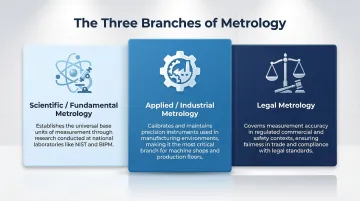
For most manufacturers, applied/industrial metrology is the primary concern — the services that keep CNC machines, gauges, and inspection equipment delivering trustworthy results.
Understanding Measurement Traceability
Every calibration result must be traceable through an unbroken chain of comparisons back to a national or international standard. In the U.S., this means traceability to NIST.
Traceability gives a measurement its credibility. When an auditor or customer asks how you know your measurements are accurate, this chain is your answer. Each link must carry its own documented measurement uncertainty:
- Your shop floor gauge
- The calibration lab's reference standard
- NIST's primary standard
Break that chain anywhere, and the measurement loses its authority.
Important clarification: Traceability applies to the measurement result, not the instrument itself. Simply owning a calibrated tool isn't enough — you must be able to demonstrate that your measurement process transfers values and uncertainties through an unbroken chain back to the International System of Units (SI).
Metrology vs. Calibration
Calibration is one of the core activities within applied metrology, but it's not the whole picture.
Calibration is the process of comparing a measurement instrument's output to a known reference standard and documenting how closely they agree. Modern standards define it as a two-step operation: first, establishing the relationship between the standard and the instrument's indication; second, using that relationship to obtain accurate measurement results.
Metrology services include calibration plus dimensional inspection, measurement system validation, uncertainty analysis, and documentation management. Calibration is essential — but it's one piece of a larger system that keeps your measurements reliable from the shop floor to the inspection report.
What Do Metrology Services Include? Common Examples
Instrument Calibration
The most widely used metrology service involves comparing measuring devices — micrometers, calipers, gauges, torque wrenches, temperature probes, pressure gauges — against traceable reference standards. Technicians document deviations and make adjustments if needed.
The result is a calibration certificate showing the instrument's accuracy status, including:
- Before and after measurements
- Deviations from the standard
- Pass/fail status
- Traceability information
- Calibration date and next due date
CNC Machine Tool Calibration and Verification
For CNC environments, machine tool calibration goes beyond individual instruments to verify the entire production system. Technicians evaluate:
- Positioning accuracy — Does each axis move to commanded positions precisely?
- Repeatability — Can the machine return to the same position consistently?
- Straightness — Do axes travel in true linear paths?
- Squareness — Are perpendicular axes properly aligned?
This catches geometric errors, axis positioning drift, and thermal expansion before they show up in finished parts. Sarkinen Calibrating offers NIST-traceable CNC machine calibration accurate to 1.0 parts per million — well beyond the 10:1 ratio required for reliable results — serving machine shops and production facilities in Portland OR and SW Washington.
Dimensional Inspection Services
Physical parts are measured against engineering drawings or CAD specifications to verify they fall within required tolerances. Common tools include:
- Coordinate measuring machines (CMMs)
- Laser scanners
- Optical comparators
- Height gauges and surface plates
This service is essential for first article inspection, incoming inspection, and investigating quality escapes when parts fail downstream.
Measurement System Analysis (MSA) and Gauge R&R
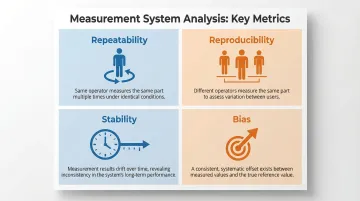
Dimensional inspection confirms whether parts meet spec — but MSA and Gauge R&R go one level deeper, evaluating whether the measurement system itself produces consistent results.
Key metrics evaluated:
- Repeatability — same operator, same part, multiple measurements
- Reproducibility — different operators measuring the same part
- Stability over time (do results drift between measurement sessions?)
- Bias — systematic offset between measured and true values
A gauge can pass calibration and still produce unreliable data if the surrounding process has high variability. That variability causes false rejects (scrapping good parts) and false accepts (shipping defective parts) — both expensive problems that calibration alone won't catch.
Calibration Management and Documentation
Providers track calibration due dates, maintain records, and issue certificates that satisfy ISO 9001, AS9100, IATF 16949, and other quality management system requirements.
Auditors and customers don't take your word for it — they want documented proof that your measurements are traceable and current. Manufacturers without that paper trail risk failed audits and lost supplier certifications, sometimes discovering the gap only after a customer has already pulled their business.
Who Uses Metrology Services?
Metrology services are used across every industry where measurement accuracy affects safety, quality, or regulatory compliance.
Key User Groups
Manufacturing facilities and machine shops are the most common users — any operation running CNC machines, precision lathes, or rotary axis equipment has processes that depend on measurement accuracy.
- Aerospace and defense: Tolerances often reach thousandths of an inch. According to Modern Machine Shop's Top Shops data, 44.4% of elite facilities run 5-axis positioning and contouring operations, requiring rigorous calibration protocols.
- Pharmaceutical and medical device manufacturers: Measurement errors affect patient safety and regulatory compliance directly.
- Automotive suppliers: Must hit strict OEM tolerance requirements. IATF 16949 mandates Measurement Systems Analysis for all inspection and test equipment.
- Electronics and semiconductor manufacturers: Component dimensions are microscopic, requiring the most advanced metrology capabilities.
The Manufacturing and Machine Shop Reality
When a CNC machine drifts out of tolerance, every part it produces is a potential defect. Research shows that measurement errors account for 22% of product defects, costing U.S. manufacturers $10 billion annually. Scrap and rework consume between 0.6% and 2.2% of total manufacturing revenue.
For machine shops running tight tolerances and thin margins, a single uncaught drift event can erase weeks of profit in scrap and rework costs alone.
Verifying New Equipment
One of the highest-leverage moments to use metrology services is when commissioning new equipment. Before a machine goes into full production, calibration confirms whether it actually meets the manufacturer's promised specifications. If it doesn't, facilities have objective, documented evidence to pursue a warranty claim — while coverage is still active.
Why Metrology Services Matter on the Production Floor
The Invisible Problem: Measurement Drift
Measurement instruments and production machines drift over time due to use, vibration, temperature changes, and mechanical wear. Without regular verification, this drift is invisible — equipment appears functional while silently producing out-of-spec parts.
By the time the problem is discovered, the damage has already accumulated:
- Scrapped parts and expensive rework
- Customer complaints and returns
- Failed quality audits
- Warranty claims
Metrology services make drift visible before it becomes costly.
Production Efficiency and Predictability
When equipment is calibrated and verified on a predictable schedule, production runs more consistently. Operators can trust their measurements, adjustment time between jobs decreases, and setup errors decline.
As Sarkinen Calibrating's founder Larry — who started as a machine operator — puts it: "Imagine a world without unexpected downtime." Proactive metrology is how you get there: fewer surprises, tighter setups, and production you can actually plan around.
The Cost of Unplanned Downtime
That efficiency gap has a dollar figure attached to it. Unplanned downtime costs U.S. manufacturers $50 billion annually, averaging $260,000 per hour for large manufacturers. Equipment failures drive 42% of these incidents.
Scheduled calibration visits cost a fraction of a single emergency shutdown. The math on prevention is straightforward.
Compliance and Audit Requirements
Customers, OEM partners, and regulatory bodies require suppliers to demonstrate that their measurement systems are calibrated and traceable.
Key standards mandate:
- ISO 9001:2015 (Clause 7.1.5.2) — Measuring equipment must be calibrated at specified intervals against traceable standards, identified to determine status, and safeguarded from adjustment
- AS9100 Rev D (Clause 7.1.5.2) — Requires a documented register of items needing calibration, including equipment type, unique ID, location, method, frequency, and acceptance criteria
- IATF 16949:2016 (Clause 7.1.5.1.1) — Requires statistical studies (MSA) for each type of inspection and measurement equipment
Without documented metrology services, manufacturers risk losing certifications, failing audits, and being disqualified from supply chains. IATF global oversight data consistently ranks calibration documentation among the top ten major nonconformities.
New Equipment Verification
Metrology services provide objective, third-party evidence that a new machine performs as promised before warranty coverage expires. This protects capital investment and gives facilities documented leverage with equipment manufacturers if adjustments or repairs are needed.
How to Choose a Metrology Service Provider
NIST Traceability Is Non-Negotiable
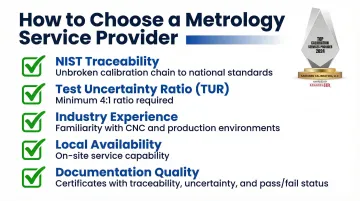
Any legitimate provider should demonstrate that their reference standards are traceable to NIST or an equivalent international standard through an unbroken chain of calibration.
When evaluating providers, ask specifically about their Test Uncertainty Ratio (TUR). Modern standards call for a 4:1 TUR — which accounts for environmental and procedural errors that the older 10:1 TAR ignored. Providers who meet or exceed this threshold deliver a more realistic, reliable picture of measurement quality.
Industry-Specific Experience and Local Availability
A provider who understands CNC machining environments, production floor realities, and the specific instruments used in your facility will deliver faster, more relevant service than a generalist lab.
Local providers also minimize the time production equipment sits idle. Before committing, ask about:
- Turnaround times from scheduling to completed service
- On-site service availability
- Experience with your specific equipment types (CNC routers, rotary axis machines, large-format machining centers)
Sarkinen Calibrating serves Portland OR and SW Washington, performing on-site CNC calibration directly at customer facilities — including linear axis, rotary axis, and ballbar testing for machine condition monitoring.
Documentation Quality and Compliance Support
The provider should deliver clear calibration certificates that include:
- Traceability information linking results back to NIST/SI standards
- Measurement uncertainty values
- Pass/fail status with decision rules
- Calibration date and next due date
- Before and after readings (if adjustments were made)
Auditors and customers will scrutinize these certificates. Certificates that include all of the above satisfy the documentation requirements for ISO 9001, AS9100, and most other quality management standards — without requiring additional follow-up from your team.
Frequently Asked Questions
What are metrology services?
Metrology services are professional activities — including calibration, inspection, and measurement verification — carried out by qualified specialists to ensure that instruments and production equipment deliver accurate, traceable measurements that meet industry and regulatory standards.
What are examples of metrology services?
Common examples include instrument calibration (calipers, gauges, torque tools), CNC machine tool calibration and verification, dimensional inspection of manufactured parts using CMMs or laser scanners, measurement system analysis (gauge R&R studies), and calibration documentation management for quality audits.
Who uses metrology services?
Manufacturing facilities, machine shops, aerospace and defense suppliers, automotive manufacturers, pharmaceutical companies, and electronics producers — any operation where measurement accuracy affects product quality, safety, or regulatory compliance.
What is the difference between metrology and calibration?
Metrology is the broader science of measurement; calibration is one specific activity within it — comparing an instrument's output to a traceable reference standard and documenting the result. Metrology services extend beyond calibration to include dimensional inspection, measurement system analysis, and uncertainty evaluation.
What is NIST traceability and why does it matter?
NIST traceability means a measurement result can be linked through an unbroken chain of documented calibrations back to national reference standards. It gives measurements credibility for internal quality control, customer requirements, and regulatory audits.
How often should metrology services be performed?
Calibration frequency depends on instrument type, usage intensity, operating environment, and required tolerances. High-use instruments in harsh environments need more frequent calibration than lightly used tools in controlled conditions.