Introduction
Manufacturing performance doesn't live or die by equipment alone. Even the best CNC machines, precision presses, and automated systems underperform when the people running them aren't properly trained. A $500,000 machining center operated by an undertrained worker delivers the same inconsistent output as a machine running at the edge of failure.
Training is frequently treated as a one-time onboarding step or a compliance checkbox — something operators complete before touching a machine, then never revisit. That approach leaves real value sitting on the table.
The gap between facilities that train consistently and those that train reactively shows up in first-pass yield, OEE scores, and incident reports. The difference isn't abstract.
This article breaks down the specific, measurable ways consistent training transforms manufacturing performance — from scrap reduction and downtime prevention to quality output and workforce retention.
TL;DR
- Training directly reduces defects and rework by ensuring operators follow correct procedures every time
- Untrained workers drive 23% of unplanned downtime — at $260,000 per hour, the cost adds up fast
- Safety incidents and audit failures trace back more often to training gaps than equipment failure
- Consistent training compounds: facilities that train proactively report fewer stoppages, lower scrap rates, and stronger audit results
What Is Manufacturing Training?
Manufacturing training is any structured effort to equip workers with the knowledge, skills, and procedures needed to do their jobs correctly, safely, and consistently. It covers everything from machine operation and standard operating procedures (SOPs) to safety protocols and quality standards.
Training applies across all facility roles:
- Machine operators who run production equipment and make real-time process decisions
- Maintenance technicians who troubleshoot, repair, and optimize equipment performance
- Quality personnel who inspect, measure, and verify product conformance
- Supervisors who coordinate production and enforce standards across shifts
Training as an Operational Control
Manufacturing training functions as an operational control mechanism — a structured way to keep human behavior aligned with the standards the equipment and process design were built to meet.
Consider a machine designed to hold ±0.001" tolerance. Training is what ensures the operator sets it up correctly, monitors it during the run, and catches drift before it produces scrap. The same logic applies to safety: a lockout/tagout procedure only protects workers if technicians follow it every time — not just when it's convenient.
Without that behavioral consistency, even well-designed processes and well-maintained equipment will produce variable results.
Key Advantages of Manufacturing Training
The advantages covered below are operational in nature—each one ties directly to outcomes manufacturers track on a daily and quarterly basis: quality, uptime, cost, and compliance.
Advantage 1: Consistent Output Quality and Fewer Defects
Trained operators understand exactly what "correct" looks like at each stage of production—how to set up, run, and inspect their work against defined standards. This understanding results in fewer deviations from spec and more uniform output across shifts, machines, and operators.
How training creates this advantage:
Training creates quality consistency by teaching workers to recognize tolerances, inspection criteria, and SOP requirements. They produce uniform output, catch problems at the source, and don't pass defective work downstream.
A trained operator knows when a measurement is drifting toward the edge of tolerance and adjusts before producing scrap. An untrained operator runs until the part fails inspection, or worse, reaches the customer.
Defects caught at the machine cost a fraction of defects caught at final inspection or returned by a customer. The 1-10-100 rule quantifies this: detecting a defect in-process costs $1, at final inspection costs $10, and at the customer costs $100 or more. Trained workers are the first line of quality control, and their consistency is what makes quality repeatable.
In one NIST Manufacturing Extension Partnership case study, structured training and visual management processes increased first-pass yield from 10% to 90%, while reducing total lead time from over 40 days to five days. Another facility using DMAIC methodology and operator training decreased defect rates from 22.3% to 0.7%.

Fewer defects mean:
- Less scrap material and rework labor
- Shorter lead times and more predictable delivery
- Stronger customer confidence in your ability to deliver as promised
KPIs impacted:
- First-pass yield rate
- Scrap/rework rate
- Customer return rate
- Defect cost per unit
- Production variance
Quality consistency through training is most critical in high-volume or tight-tolerance environments where small deviations multiply into significant waste, and whenever new machines, processes, or operators are introduced.
Advantage 2: Reduced Unplanned Downtime and Equipment Damage
Trained operators recognize early warning signs of trouble and respond to abnormal conditions before they escalate into failures or costly repairs. That ability to intervene early is what separates a five-minute correction from a five-hour shutdown.
How training creates this advantage:
Workers who understand their equipment's normal operating behavior detect vibration changes, unusual outputs, or measurement drift and escalate appropriately, rather than pushing through and causing damage. They know when a spindle sounds different, when a hydraulic pressure reading is off, or when a part dimension is trending out of spec.
That situational awareness is what prevents small issues from becoming catastrophic failures.
Unplanned downtime costs manufacturers an average of $260,000 per hour, and human error accounts for 23% of these incidents. Most unplanned downtime traces back to avoidable causes: improper operation, missed maintenance cues, or failure to follow setup procedures — all of which training directly addresses.
Reducing unplanned stops improves OEE, preserves equipment life, and removes the scheduling chaos that ripples through an entire production run when a machine goes down unexpectedly. One facility achieved a 6% increase in OEE and $152,000 in yearly cost savings by providing operators with real-time performance visibility and training.
For facilities running CNC machines or precision equipment, training gains only hold when the machines themselves are accurate. Pairing operator training with regular NIST-traceable calibration — from a provider like Sarkinen Calibrating — ensures that performance improvements aren't undermined by equipment drift. When both the operator and the machine are held to the same standard, results are consistent and verifiable.
KPIs impacted:
- Overall equipment effectiveness (OEE)
- Mean time between failures (MTBF)
- Unplanned downtime hours
- Maintenance cost per machine
- Equipment lifespan
This advantage is highest-impact in facilities running continuous production, multi-shift operations, or expensive precision equipment, where a single unplanned stop disrupts scheduling and incurs labor and repair costs that compound quickly.
Advantage 3: Stronger Safety Performance and Compliance Readiness
Manufacturing training embeds safe work behaviors into daily routines. Done consistently, it becomes a reinforced standard that shapes how workers interact with equipment, hazardous materials, and each other — not a compliance checkbox they completed during onboarding.
How training creates this advantage:
Facilities with regular safety refreshers, updated procedure training, and clear compliance documentation are less likely to experience incidents and are always audit-ready, rather than scrambling before inspections. Workers who receive ongoing safety training don't just know the rules — they understand the reasons behind them and apply them consistently.
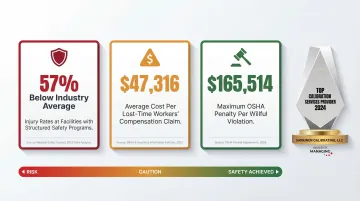
Safety incidents carry costs far beyond the injury itself: OSHA penalties, lost production time, workers' compensation claims, and reputational damage. According to OSHA's 2021 evaluation, facilities participating in structured safety training programs achieved injury rates 57% below their industry averages. Consistent training reduces the frequency and severity of these events by keeping safe behaviors current and top of mind.
The average cost for a lost-time workers' compensation claim in 2022-2023 was $47,316, and OSHA violations can carry penalties up to $165,514 per willful violation. Industries with compliance-heavy requirements (ISO, OSHA, customer quality audits) benefit from training that maintains audit-ready documentation and ensures workers can demonstrate procedural adherence, not just claim it.
KPIs impacted:
- Recordable incident rate (TRIR)
- OSHA violation frequency
- Audit pass rates
- Workers' compensation costs
- Near-miss reports
Safety and compliance training is highest-impact in environments handling hazardous materials, operating heavy or automated equipment, or subject to regular third-party audits and customer certification requirements.
What Happens When Training Is Missing or Ignored
The consequences of undertrained workers rarely surface all at once. They build up across quality reports, maintenance logs, and incident records until they're impossible to ignore.
Common operational consequences of training gaps:
- Inconsistent output: Workers operating from memory or habit rather than procedure produce variable results, making quality control reactive rather than predictive
- Higher error and scrap rates: Without training reinforcement, mistakes that should have been caught early become costly defects that are far harder to fix later
- Reactive firefighting: Supervisors spend disproportionate time correcting problems that trained workers would have prevented, pulling attention away from improvement and planning
- Rising operational costs: Untrained operators push machines beyond safe parameters, skip checks, and miss signs of wear — leading to avoidable repairs and unplanned service calls
- Difficulty scaling or delegating: Operations built on informal knowledge rather than documented procedure can't scale reliably. New hires inherit the same gaps, and quality becomes person-dependent instead of process-dependent
The inability to attract and retain a quality workforce is cited as the top business challenge by 63.8% of manufacturing management respondents. When training is treated as a one-time event rather than a continuous strategy, skills gaps manifest as inconsistent output, quality escapes, and longer time-to-productivity. Relying on undocumented "tribal knowledge" costs manufacturers up to $29,400 per new hire in lost productivity due to constant interruptions of senior staff and extended ramp-up times.
How to Get the Most Value from Manufacturing Training
Treating training as an ongoing operational discipline — not a periodic event — is what separates facilities that improve from those that just document. Three conditions determine whether training actually translates to better performance.
Consistency Over Frequency
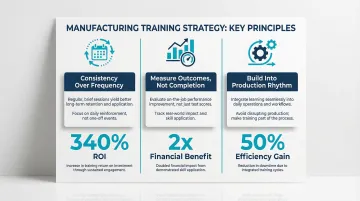
Training applied consistently across all shifts, roles, and process changes produces more reliable results than intensive periodic programs. Ensure SOPs are updated and re-trained whenever equipment, processes, or regulatory requirements change. A quarterly training blitz followed by months of silence is less effective than brief, regular reinforcement integrated into the production rhythm.
Measure Outcomes, Not Just Completion
Track whether training is moving the metrics that matter — not just logging attendance. The numbers worth watching include:
- Defect rates before and after training cycles
- Unplanned downtime frequency
- Safety incident trends by shift or role
Training that doesn't shift these numbers should be revised, not repeated. Point-of-need training yields an average ROI of 340%, compared to just 180% for traditional classroom training.
Operators trained to recognize measurement accuracy and tolerance standards only capture the full value of that knowledge when the equipment itself is verified against those same standards. If a machine is running out of tolerance, even a well-trained operator can't compensate. NIST-traceable calibration ensures the equipment matches what workers are being trained to uphold.
Build Training Into the Production Rhythm
The most effective manufacturing training happens close to the work itself — through embedded instructions, peer mentoring, and short-format refreshers that fit within shift schedules rather than pulling workers away from the floor for extended classroom sessions. Structured on-the-job training provides approximately twice the financial benefits and five times the efficiency compared to unstructured OJT.
Conclusion
Manufacturing training is ultimately a form of operational control—the mechanism by which the gap between how processes are designed to run and how they actually run gets closed every shift, not just on paper. It's what ensures that the standards built into your equipment, procedures, and quality systems are actually followed by the people who touch the work.
The advantages of consistent training compound over time. Facilities that treat training as a continuous practice rather than a reactive response build capabilities that become a genuine competitive advantage:
- Better quality output with fewer defects reaching downstream processes
- Less unplanned downtime because operators catch drift before it becomes failure
- Stronger safety performance through consistent, practiced responses
When your operators know what correct looks like and recognize when things drift, problems get resolved before they escalate. That's not just cost avoidance — it's the difference between a facility that reacts to problems and one that rarely has them.
Frequently Asked Questions
Why is training important in manufacturing?
Training ensures workers can operate equipment correctly, follow established procedures, and catch problems early—directly impacting quality, safety, and uptime across the facility. Without it, even the best equipment underperforms.
What are the 6 key points of effective employee training?
Effective training includes clear learning objectives tied to job tasks, hands-on practice, and role-specific content. It also requires consistency across shifts, regular refreshers as processes change, and measurement of whether training actually changes on-the-job behavior.
How does training reduce defects and scrap in manufacturing?
Trained operators understand correct procedures, tolerance limits, and inspection criteria—so they catch deviations at the source rather than passing defective work downstream where correction costs can multiply many times over.
How often should manufacturing employees be retrained or receive updates?
Retraining should occur whenever equipment, SOPs, or regulatory requirements change. Annual safety refreshers and periodic procedure reviews are a baseline, with higher-frequency refreshers for roles with direct quality or safety impact.
What is the connection between operator training and equipment calibration?
Training teaches operators what correct performance looks like, while calibration verifies that the machines themselves are producing accurate, in-spec output. Skip either one, and the other stops compensating—output quality suffers regardless of how well the other is managed.