Do lasers need to be calibrated?
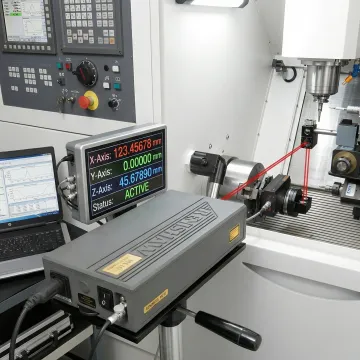
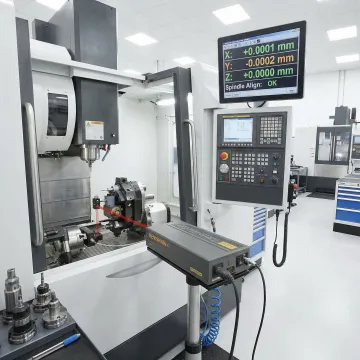
Yes, laser measurement systems require periodic calibration to maintain accuracy. At Sarkinen Calibrating, our laser interferometers are calibrated and traceable to NIST standards, ensuring measurements accurate to 1.0 parts per million. This traceability guarantees that when we calibrate your CNC machines, the results are reliable and meet industry standards.
How often should CNC machines be calibrated?
Calibration frequency depends on machine usage, part tolerances, and production requirements. Most manufacturers calibrate annually, but high-precision or high-volume operations may require quarterly or semi-annual calibration. We recommend calibrating after machine relocation, major repairs, or when part quality issues arise.
What's the difference between ballbar testing and laser calibration?
Ballbar testing provides a quick health check, identifying issues like backlash, servo mismatch, and squareness problems through circular motion tests. Laser calibration offers comprehensive measurement of linear positioning accuracy, straightness, and repeatability across full axis travel. Both services complement each other for complete machine verification.
Can you calibrate machines while they're still under warranty?
Absolutely. We recommend calibrating new machines while under warranty to verify they meet manufacturer specifications. Shipping and installation often introduce alignment errors or hidden damage. Early calibration identifies these issues before they impact production, giving you documentation to address problems with the manufacturer.
How long does laser calibration take?
A typical three-axis machine calibration takes 4-8 hours depending on machine size and axis travel. Ballbar testing is faster, typically 1-2 hours. We work efficiently to minimize downtime and can often schedule service during non-production hours to avoid disrupting your operations.
What documentation do you provide after calibration?
You receive a comprehensive calibration report with NIST-traceable measurements, error plots, and clear documentation of machine accuracy across all tested axes. Reports include positioning accuracy, repeatability, straightness, and squareness data, providing proof of machine capability for customer audits and quality requirements.
Do you offer calibration services outside Portland and SW Washington?
Yes, while we focus on serving Portland and SW Washington with faster response times, we also provide calibration services to customers outside our primary service area. Contact us to discuss your location and scheduling needs.
What happens if calibration reveals accuracy problems?
Our reports clearly identify the source and severity of accuracy issues, whether they're from mechanical wear, alignment problems, or control system errors. We can recommend corrective actions and, if needed, connect you with qualified service technicians. Follow-up calibration verifies that repairs restored proper accuracy.