How do you calibrate a CNC machine?
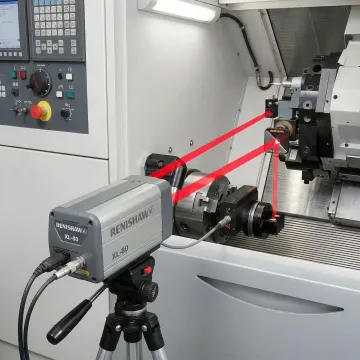
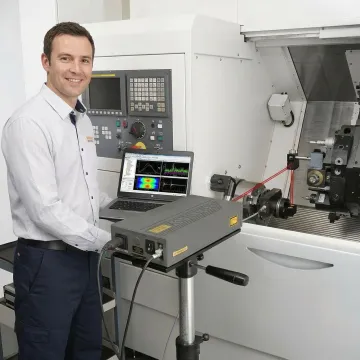
CNC machine calibration uses laser interferometry to measure positioning accuracy, repeatability, straightness, and squareness of each axis across its full travel. A Renishaw laser system captures thousands of data points with precision to 1.0 parts per million, comparing actual machine movement against programmed commands. The process identifies errors from mechanical wear, thermal effects, scale inaccuracies, and alignment issues. Results are analyzed to determine which errors can be compensated through machine parameters versus which require physical repair. Calibration also includes ballbar testing for circular interpolation accuracy and electronic leveling for pitch and roll verification.
How often should CNC machines be calibrated?
Calibration frequency depends on machine usage, required part tolerances, and manufacturer recommendations. High-precision operations typically calibrate quarterly or semi-annually, while general machining may calibrate annually. New machines should be calibrated immediately after installation to verify specifications while under warranty. Recalibration is also recommended after machine relocation, major repairs, collision events, or when parts consistently fall out of tolerance. Regular ballbar testing between full calibrations provides quick performance snapshots.
What accuracy can laser interferometry achieve?
Renishaw laser interferometer systems used by Sarkinen Calibrating achieve accuracy to 1.0 parts per million, equivalent to one millionth of an inch per inch of travel. This precision far exceeds the 10:1 ratio required for proper calibration standards. All measurements are fully traceable to NIST and International Standards, providing documented proof of machine capability for quality audits and customer requirements.
How long does machine calibration take?
Calibration duration varies by machine size and number of axes. A typical 3-axis milling machine requires 4-8 hours for complete linear calibration including setup, measurement, and analysis. Ballbar testing takes 1-2 hours and provides rapid performance evaluation. 5-axis machines with rotary components require additional time for rotary axis verification. Our local Portland service minimizes scheduling delays and production disruption.
What is included in the calibration report?
Calibration reports include comprehensive data for each measured axis showing positioning accuracy, repeatability, straightness, and squareness across full travel. Graphical representations compare actual performance against manufacturer specifications and ISO standards. Reports identify specific error sources, indicate compensable versus mechanical issues, and provide prioritized recommendations. All measurements are NIST-traceable and suitable for warranty claims, quality audits, and customer documentation requirements.
Can calibration fix machine accuracy problems?
Calibration identifies and quantifies accuracy problems, and many errors can be corrected through machine parameter compensation without physical repairs. Systematic errors like scale inaccuracies, backlash, and some thermal effects are compensable through controller adjustments. However, mechanical issues like worn bearings, damaged ball screws, or structural problems require physical repair. Calibration data clearly distinguishes between compensable and mechanical errors, providing actionable information for maintenance decisions.
Do you calibrate machines outside Portland and SW Washington?
While Sarkinen Calibrating is based in Portland OR serving SW Washington with faster response times than out-of-area providers, out-of-area calibration service is also available. Our primary service areas of Portland OR and SW Washington receive priority scheduling and same-day mobilization when needed. Contact us to discuss your location and calibration requirements.
What should I do to prepare for machine calibration?
Ensure the machine is clean and free of coolant or debris that could interfere with measurement equipment. Allow the machine to reach thermal equilibrium by running it through typical warm-up cycles. Clear the work area and provide safe access to all machine axes. Have maintenance records and any accuracy concerns documented. Our technician will coordinate specific requirements during pre-calibration planning to ensure efficient service delivery.