What is the cost of calibration?
Calibration costs vary based on equipment type, number of axes, measurement complexity, and service location. Factors include whether you need linear, rotary, ballbar, or surface plate calibration. We provide detailed quotes after understanding your specific equipment and requirements. Contact us for a customized estimate based on your machinery and production needs.
How often do balances need to be calibrated?
Calibration frequency depends on equipment usage, precision requirements, and manufacturer recommendations. High-precision manufacturing typically requires annual calibration, while heavily used machines may need quarterly or semi-annual service. New machines should be verified immediately after installation while still under warranty. We help establish optimal calibration schedules based on your production demands and quality standards.
How long does calibration take?
Most calibration services are completed in 4-8 hours depending on machine size and complexity. Ballbar testing takes 1-2 hours and provides rapid machine health assessment. Linear calibration on multi-axis machines may require a full day. We schedule efficiently to minimize production disruption and provide accurate time estimates during planning.
Are your measurements traceable to NIST?
Yes, all measurements are fully traceable to NIST and International Standards. We use calibrated equipment that exceeds the required 10:1 accuracy ratio, with laser interferometry accurate to 1.0 parts per million (one millionth of an inch per inch). Complete documentation supports ISO compliance and customer audits.
Do you calibrate machines at our facility?
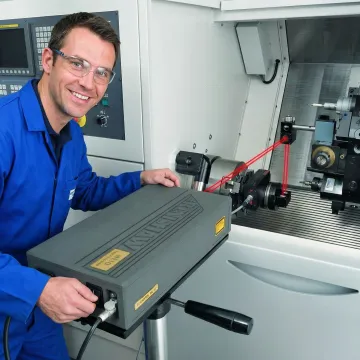
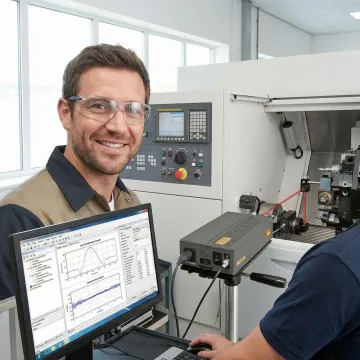
Yes, all calibration services are performed on-site at your facility. Our portable equipment including Renishaw laser interferometers, QC20-W Ballbar, and electronic levels allow complete calibration without moving machinery. On-site service eliminates transportation risks and allows immediate identification of installation or foundation issues.
What equipment can you calibrate?
We calibrate CNC mills, lathes, machining centers, coordinate measuring machines (CMMs), large CNC routers, machines with rotary axes, surface plates, and precision inspection equipment. Our services cover linear positioning, rotary accuracy, levelness, straightness, squareness, and circularity across various machine types and sizes.
Will calibration fix accuracy problems?
Calibration identifies accuracy problems and quantifies their impact. Once issues are documented, corrections may include machine adjustments, realignment, component replacement, or software compensation. We provide clear guidance on necessary corrective actions and can verify improvements through follow-up measurements.
How do I know if my machine needs calibration?
Signs include inconsistent part dimensions, increased scrap rates, difficulty holding tolerances, new machine installation, relocation, collision damage, or inability to pass customer audits. Regular preventive calibration catches problems before they affect production. We recommend verification whenever machine accuracy becomes questionable or before critical production runs.