What is CNC laser calibration and why is it necessary?
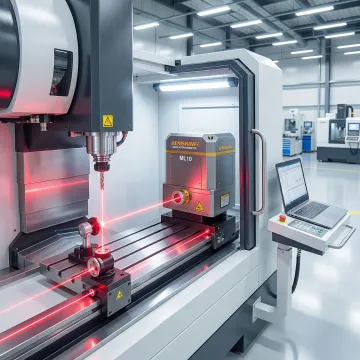
CNC laser calibration uses laser interferometry to measure machine tool positioning accuracy, repeatability, straightness, and squareness with extreme precision. It's necessary because shipping, installation, wear, and environmental factors cause machines to drift from factory specifications over time. Regular calibration ensures your machines produce accurate parts consistently, helps verify warranty specifications on new equipment, and identifies problems before they affect production quality.
How accurate are your CNC calibration measurements?
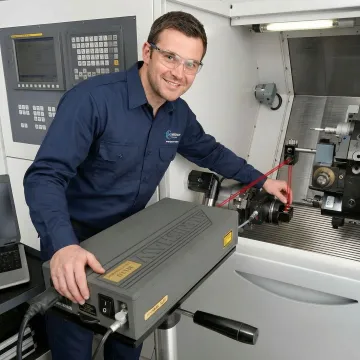
Our measurements using Renishaw's Laser Interferometer achieve accuracy to 1.0 part per million, which equals one millionth of an inch per inch. This exceeds the industry-required 10:1 ratio for proper calibration and is fully traceable to NIST and International Standards. This level of precision allows us to detect even microscopic errors that could affect part quality.
How long does CNC machine calibration take?
Calibration time varies based on machine size, number of axes, and testing scope. A basic 3-axis ballbar test can be completed in 1-2 hours, while comprehensive linear calibration on multiple axes typically requires 4-8 hours. We work closely with your production schedule to minimize downtime, and our wireless Ballbar system enables particularly fast setup and measurement.
How often should CNC machines be calibrated?
Calibration frequency depends on machine usage, criticality of parts, and manufacturer recommendations. Generally, annual calibration maintains optimal performance for most production environments. However, high-volume operations, precision work requiring tight tolerances, or machines showing accuracy problems may benefit from semi-annual calibration. We help establish appropriate intervals based on your specific operations and baseline performance data.
What's included in your calibration reports?
Our comprehensive reports include raw measurement data, graphical analysis showing error distribution across axis travel, comparison to machine specifications, identification of specific error sources, and clear recommendations for corrective actions. You receive certification documentation traceable to NIST standards, before-and-after data when adjustments are made, and actionable insights for preventive maintenance planning.
Can you calibrate machines while they're still under warranty?
Yes, and this is highly recommended. Independent calibration while machines are under warranty helps verify that equipment meets promised specifications before the warranty expires. Shipping and installation often introduce alignment errors or hidden damage that may not be immediately apparent. Our documentation provides clear proof of any issues, protecting your investment and ensuring problems are addressed while manufacturer coverage is still active.
Do you service locations outside Portland and SW Washington?
Yes, while we're based in Portland OR and serve SW Washington with faster local response times, we also provide calibration services to customers outside our primary area. Our local expertise and advanced equipment travel well, though response times may be longer for distant locations. Contact us to discuss your specific location and calibration needs.
What types of machines can you calibrate?
We calibrate all types of CNC machine tools including milling machines, machining centers, lathes, routers, and multi-axis equipment with rotary tables or trunnions. Our services extend to large-format machines, long-travel equipment, and specialized manufacturing systems. We also verify surface plates, guideway geometry, and machine foundations. If your equipment affects part accuracy, we can likely measure and calibrate it.